
Can Invisalign Fix an Overbite? What Aligners Can and Can't Do
Yes, Invisalign can fix an overbite when the extra overlap comes from tooth position. An overbite is how far the top front teeth cover the bottom ones, unlike overjet, which is front to back. Aligners reduce it by moving front teeth into the bone and letting back teeth rise, typically over 12 to 24 months [1][4][7].
· Dr. Basma Fallah
TL;DR
An overbite is vertical overlap of the front teeth. Buck teeth are overjet, a separate front-to-back problem [1][2].
Aligners treat overbites caused by tooth position. Jaw-driven overbites may need growth guidance or, in severe adult cases, surgery [1].
Aligners reduce a deep bite by moving front teeth into the bone, leveling the back teeth, and using bite ramps and attachments [4].
Studies show aligners deliver only part of the planned overbite change per round, so overcorrection and refinements are normal [5][6].
Elastics on precision cuts or buttons fix the front-to-back part of a bite [10].
Align puts typical overbite treatment at about 12 to 24 months [7][8].
A retainer holds the result, usually for life with less wear over time [13].
One liner: Aligners can fix an overbite caused by tooth position, once an exam confirms the problem is vertical overlap and that the jaws are not the main cause.
Key numbers
12 to 24 months: Typical Invisalign overbite treatment time stated by Align ([7], 2023)
2 to 4 mm: Overlap Cleveland Clinic treats as normal; more counts as an overbite ([3], 2026)
39.2%: Share of planned overbite reduction delivered by aligners in 42 adults ([5], 2021)
33%: Average overbite correction after the first set of aligners in deep bite patients ([6], 2023)
45%: Share of adult and teen patients Align estimated present with a deep bite ([4], 2013)
2014: Year Align introduced precision bite ramps for deep bite treatment ([11], 2018)
Ages 10 to 16: Main age range for Align's mandibular advancement aligners ([9], 2025)
Age 7: When the AAO recommends a child's first orthodontic check-up ([12], 2026)
Yes, Invisalign can fix an overbite when the extra overlap comes from where the teeth sit, not from how the jaws grew. An overbite is how far your top front teeth cover your bottom front teeth when your back teeth close [1]. Clear aligners are one of the treatments orthodontists use for it, along with braces. Jaw surgery is kept for severe cases, mostly in adults whose jaws have finished growing [1].
So can Invisalign fix overbite problems in your mouth? Two things decide it. First, is your bite too deep, or do your top teeth stick out too far? Those are two different problems, and people often call both an overbite [2]. Second, do your teeth cause it, or your jaws? Here's how to tell.
Overbite vs Overjet: Which One Do You Have?
In short: An overbite is vertical overlap of the front teeth, and overjet is how far the top teeth sit in front. They need different tools, and many people have some of both.
An overbite is vertical: how far your top front teeth cover your bottom front teeth, top to bottom [1]. Overjet is horizontal: how far your top front teeth sit in front of your bottom ones. It's what most people picture when they say "buck teeth" [1][2].
Picture a shoebox lid. An overbite is a lid that slides too far down over the box, while overjet is a lid pushed forward so it hangs off the front edge.
A small overlap is normal. Cleveland Clinic puts normal at about 2 to 4 millimeters, and anything past that counts as an overbite, also called a deep bite [3].
What it measures. Overbite (deep bite): How far the top front teeth cover the bottom ones. Overjet: How far the top front teeth sit in front of the bottom ones.
Direction. Overbite (deep bite): Up and down. Overjet: Front to back.
Common name. Overbite (deep bite): Deep bite or closed bite. Overjet: Buck teeth or protrusion.
What you see in a mirror. Overbite (deep bite): From the front, the lower front teeth are mostly hidden. Overjet: From the side, a gap between the top and bottom front teeth.
Main tools in an aligner plan. Overbite (deep bite): Front tooth intrusion, bite ramps and attachments [4]. Overjet: Class II elastics on precision cuts or buttons [10].
To check, bite down on your back teeth and look straight into a mirror. If you can barely see your bottom front teeth, your bite is deep. Then turn sideways, where a clear gap between the top and bottom front teeth means overjet. Protruding front teeth sometimes come with a deep bite [2], so an orthodontist measures each one on its own.
Can Invisalign Fix Overbite? Dental vs Skeletal Decides It
In short: The cause decides it. Overbites from tooth position are treated with aligners, while jaw-driven overbites may also need growth guidance or, in severe adult cases, surgery.
A "severe" label doesn't settle it. The cause does. The AAO lists clear aligners among the treatments for a deep bite and keeps jaw surgery for severe cases, especially in adults whose jaws have stopped growing [1]. Align, the company that makes Invisalign, also reports that doctors correct more severe deep bites when they add precision bite ramps to the aligners [11].
Where it comes from. Dental overbite: Tooth position, such as lower front teeth that have grown up too far, a deep curve in the lower teeth, or missing lower teeth [1][4][7]. Skeletal overbite: The size or growth of the jaws, most often a lower jaw that sits too far back [2][9].
What you might notice. Dental overbite: Lower front teeth hidden when you bite, wear on the back of the upper front teeth [1]. Skeletal overbite: A deep bite plus a lower jaw and chin that sit back [9].
First approach. Dental overbite: Aligners that move the teeth up and down [4]. Skeletal overbite: Jaw growth guidance while a child is still growing, or orthodontics combined with surgery for some adults [9][1][7].
Many overbites are a mix, so the exam sorts out how much comes from teeth and how much from jaws. Two people with the same deep overlap can end up with different plans for that reason. If yours is mostly dental, the aligners do the work by moving teeth, and the next section shows how.
How Aligners Fix a Deep Bite
In short: Aligners press the front teeth into the bone, let the back teeth rise, and use bite ramps and attachments. Deep bites usually need overcorrection and refinements.
A deep bite gets smaller in two ways. The front teeth settle a little deeper into the bone, and the back teeth come up a little. Aligner plans use both, and Align built a set of features for this exact job [4].
Deep Bite Aligners: What Does the Work
1. Intrusion. The aligners press the front teeth gently into the bone so they overlap less [4].
2. Leveling. Many deep bites have a lower arch that dips in the middle, called the curve of Spee. Letting the premolars rise flattens that dip [4].
3. Bite ramps. Small bumps on the inside of the upper aligner keep the back teeth slightly apart, giving them room to come up [4].
4. Attachments and pressure areas. Tooth-colored bumps bonded to some teeth, plus shaped spots in the plastic, give the aligner grip to push in the right direction [4].
Deep bites are one of the harder jobs for aligners. In a study of 42 adults, treatment delivered 39.2% of the overbite change the planning software predicted, on average. Deeper starting bites showed bigger gaps [5]. A 2023 study found about 33% after the first set of aligners, and most of its deep bite patients needed overcorrection and refinements [6].
As a rough picture, a plan to reduce a bite by 4 millimeters might show about 1.5 millimeters after the first set. So orthodontists overcorrect on purpose and order refinements, which are extra rounds of aligners made from a new scan. In a deep bite case, that's part of the plan, not a setback.
Where Elastics and Precision Cuts Fit In
In short: Elastics hooked to precision cuts or buttons fix the front-to-back part of a bite. The vertical overlap is handled by intrusion and bite ramps.
Rubber bands, called elastics, handle the front-to-back part of a bite. With aligners, they hook onto precision cuts, small notches in the edge of the tray. Some plans use buttons instead, which are tooth-colored knobs bonded to a tooth [10].
In a common Class II setup, the band runs from near the upper canine back to a lower molar. That pull changes how the upper and lower teeth line up front to back, which shrinks overjet [10]. The vertical overlap is handled by the intrusion and bite ramps from the last section.
So someone with buck teeth and a normal overlap may need elastics and little else. Someone with buck teeth and a deep bite needs both sets of tools in one plan [2][10]. Elastics only work while they're on. Your orthodontist will tell you how many hours a day to wear them and when to put in fresh ones.
How Long to Fix Overbite With Invisalign
In short: Align puts typical overbite treatment at about 12 to 24 months. Deeper bites, refinements, elastics, and growth phases push it longer.
Align, the maker of Invisalign, says overbite treatment typically takes about 12 to 24 months, depending on the case [7][8]. You may see shorter numbers online, but they don't come from the manufacturer. Aligners also only move teeth while they're in your mouth, so the plan only works if you wear them as directed.
A deeper starting bite: The gap between planned and real movement grows as the bite gets deeper [5]
Refinement rounds: Each round means a new scan and a new set of aligners [6]
Overjet that needs elastics: The plan has a second job, fixing front-to-back position too [10]
A growth phase: Growing patients may spend time moving the lower jaw forward with mandibular advancement [9]
Your own estimate comes from the exam. A good written plan lists the expected length, the chance of refinements, and whether elastics are part of it.
Skeletal Overbites That Need a Different Plan
In short: Growing patients can have a set-back lower jaw guided with mandibular advancement aligners. Adults with severe skeletal deep bites may need surgical orthodontics.
When the jaws cause the overbite, moving teeth alone may not be enough. The biggest thing that changes the plan is whether the patient is still growing.
Growing Kids and Teens
A lower jaw that sits back can often be guided while a child is still growing. Align makes aligners with mandibular advancement, which use precision wings or occlusal blocks to hold the lower jaw forward while the teeth straighten. They're meant for growing patients with a set-back lower jaw, mainly ages 10 to 16 [9].
Timing matters here. The AAO recommends a first orthodontic check-up by age 7, when the mix of baby and adult teeth can show problems early [12].
Adults Whose Jaws Have Stopped Growing
After growth ends, the jaw can't be guided anymore. For severe skeletal deep bites, the AAO describes surgical orthodontics, where orthognathic surgery repositions the jaw bones as part of treatment [1][7]. Not every jaw-related overbite in an adult goes that route, since the AAO keeps surgery for severe cases [1]. The call comes from a full exam with imaging.
Keeping the Result
In short: A retainer holds the corrected bite, usually for life with less wear over time. Retainers can include bite ramps for deep bite cases.
Teeth tend to drift back toward where they started, so every corrected bite needs a retainer [13]. For deep bites, Align makes Vivera retainers with precision bite ramps, the same kind of bumps used on the aligners, to give extra support after deep bite correction [11].
The AAO says a retainer is usually needed for life, though how often you wear it can drop over time [13]. Your orthodontist sets that schedule based on how your bite settles.
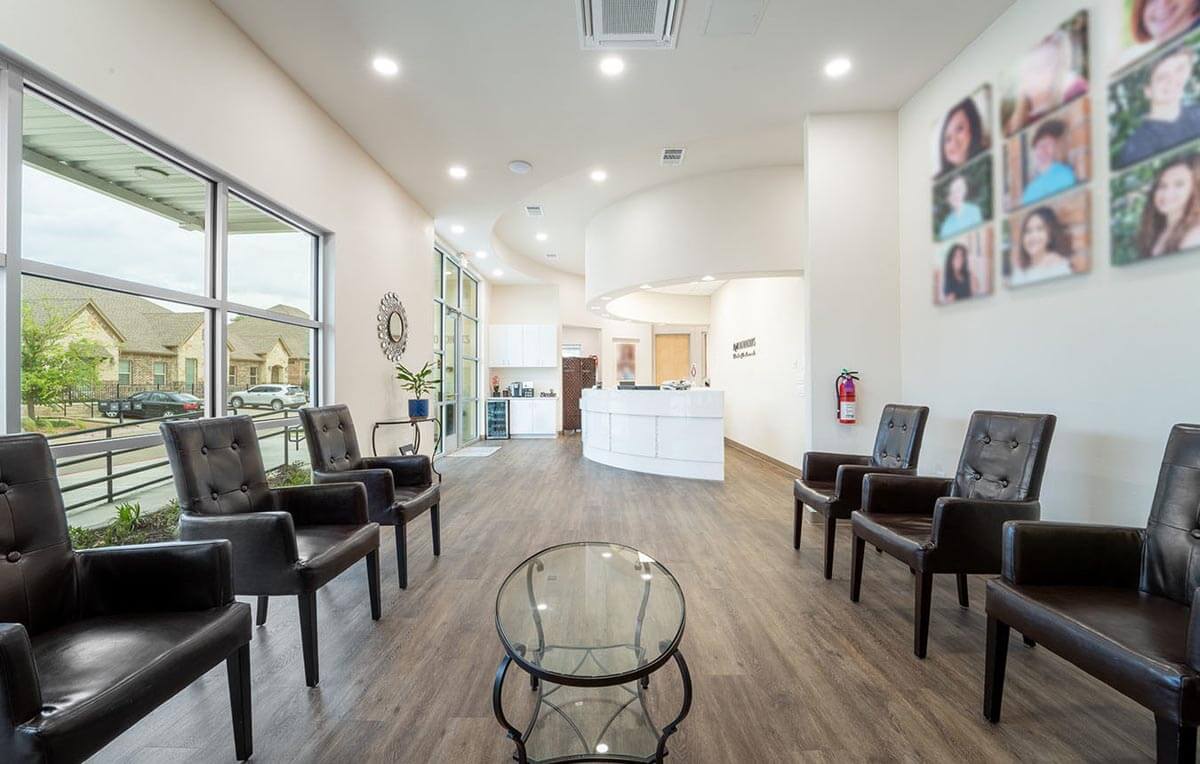
What an Evaluation in North Richland Hills Checks
In short: The first visit at NRH Orthodontics includes 3D records with a CBCT airway evaluation and a written plan with fees before you commit.
At NRH Orthodontics, the first visit starts with full records, including 3D imaging with a CBCT airway evaluation, and Dr. Basma Fallah reviews them herself [14]. That's how the exam separates an overbite from overjet, and teeth from jaws. You leave with a written diagnosis, a plan with the estimated length of treatment, and the fees in writing, with no commitment required [14].
The practice is aligner-first. Sectional braces are used only as a short step when a specific tooth movement needs them [15]. She has been a Diplomate of the American Board of Orthodontics since 2007, and she reviews weekly remote scans for aligner patients, so a bite that isn't opening on schedule gets caught early [15]. To book an evaluation, call (817) 581-8881.
Frequently Asked Questions
In short: Quick answers on rubber bands, severe cases, face changes, starting age, relapse, causes, and whether a deep bite is worth treating.
Can Invisalign fix an overbite without rubber bands?
Often, yes, when the problem is mainly vertical. Front tooth intrusion and bite ramps do most of that work [4]. Elastics usually come in when overjet, the front-to-back gap, also needs fixing [10].
Can Invisalign fix a severe overbite?
It depends on the cause. Align reports that doctors correct more severe deep bites when they add precision bite ramps [11]. Severe overbites caused by the jaws in adults may need surgical orthodontics instead [1].
Does Invisalign overbite correction change your face?
In growing teens, Align says mandibular advancement can improve the look of the chin [7]. In adults, aligners move teeth. Repositioning the jaw bones takes surgery [1].
What age can a child start treatment for an overbite?
The AAO recommends a first orthodontic check-up by age 7 [12]. Align's aligners with mandibular advancement are meant mainly for growing patients ages 10 to 16 [9].
Will my overbite come back after Invisalign?
It can, because teeth tend to drift back. The AAO says a retainer is usually needed for life, though you may wear it less often over time [13].
What causes a deep bite?
Tooth position, jaw growth, or both. The AAO lists childhood habits, early loss of baby teeth, overdevelopment of supporting bone, and differences in jaw growth among the causes [2].
Is a deep bite worth fixing if it doesn't hurt?
It's worth an exam. The AAO says deep bites typically don't resolve on their own and can wear down front teeth, damage the gums, or cause sores on the roof of the mouth [1].
Key Terms
In short: Plain-English definitions of the terms used above.
Overbite: How far the upper front teeth cover the lower front teeth, measured top to bottom. Too much is called a deep bite [1].
Deep bite: Another name for an excessive overbite, where the upper front teeth cover the lowers too far [1].
Overjet: How far the upper front teeth sit in front of the lower front teeth, measured front to back [1].
Protrusion: Front teeth that sit too far forward, often called buck teeth. It can occur with a deep bite [2].
Class II: A bite where the lower teeth and jaw sit back compared with the upper teeth and jaw [9][10].
Curve of Spee: The dip in the lower arch between the front and back teeth. A deep curve often comes with a deep bite [4].
Intrusion: Moving a tooth slightly deeper into the bone. Aligners use it on front teeth to reduce an overbite [4].
Extrusion: Letting a tooth come up out of the bone a little, used on premolars to level the bite [4].
Precision bite ramps: Small bumps on the inside of the upper aligner that keep the back teeth slightly apart [4][11].
Attachments: Small tooth-colored bumps bonded to teeth so the aligner can grip and push in a set direction [4].
Precision cuts: Small notches in the aligner edge where elastics hook on [10].
Elastics: Rubber bands that connect the upper and lower aligners to correct front-to-back position [10].
Refinement: An extra round of aligners made from a new scan when teeth have not reached the planned position [6].
Mandibular advancement: Aligner features, precision wings or occlusal blocks, that hold a growing patient's lower jaw forward [9].
Orthognathic surgery: Surgery that repositions the jaw bones, used with orthodontics for severe skeletal cases [1].
CBCT: Cone beam computed tomography, a low-radiation 3D scan used in the first visit at NRH Orthodontics [14].
At a Glance
In short: Quick reference cards for the aligner features, the key study, and the practice.
Invisalign G5 deep bite features
Maker: Align Technology [4]
Introduced: 2014 [11]
Parts: Attachments, pressure areas, precision bite ramps [4]
Job: Level the curve of Spee through front tooth intrusion and premolar extrusion [4]
Mandibular advancement aligners
Maker: Align Technology [9]
Features: Precision wings or occlusal blocks [9]
For: Growing patients with a set-back lower jaw, mainly ages 10 to 16 [9]
Job: Hold the lower jaw forward while the teeth straighten [9]
Blundell et al. 2021 overbite study
Journal: American Journal of Orthodontics and Dentofacial Orthopedics [5]
Patients: 42 adults [5]
Finding: 39.2% of planned overbite reduction delivered on average [5]
Pattern: Deeper starting bites showed bigger gaps [5]
NRH Orthodontics
Location: 8601 Mid Cities Blvd, North Richland Hills, TX 76182
Orthodontist: Dr. Basma Fallah, ABO Diplomate since 2007 [15]
Approach: Aligner-first, sectional braces when a movement needs them [15]
First visit: 3D records with CBCT airway evaluation and a written plan [14]
Sources
In short: The sources behind every numbered citation above.
1. American Association of Orthodontists, Understanding Deep Bites: Causes, Concerns, and Corrections (updated 2026): https://aaoinfo.org/whats-trending/what-is-a-deep-bite/
2. American Association of Orthodontists, 7 Common Types of Bite Problems and Their Orthodontic Solutions (2026): https://aaoinfo.org/whats-trending/7-common-bite-problems/
3. Cleveland Clinic, Overbite: Causes, Symptoms and Treatment: https://my.clevelandclinic.org/health/diseases/21473-overbite
4. Align Technology, Align Technology Announces Invisalign G5 Innovations for Treatment of Deep Bite (2013): https://investor.aligntech.com/news-releases/news-release-details/align-technology-announces-invisalign-g5-innovations-treatment
5. Blundell HL, Weir T, Kerr B, Freer E. Predictability of overbite control with the Invisalign appliance. American Journal of Orthodontics and Dentofacial Orthopedics, 2021;160(5):725 to 731: https://pubmed.ncbi.nlm.nih.gov/34373153/
6. Predictability of the deep overbite correction using clear aligners. American Journal of Orthodontics and Dentofacial Orthopedics (2023): https://www.sciencedirect.com/science/article/abs/pii/S0889540623000070
7. Invisalign.com, How to Fix Overbite (December 2023): https://www.invisalign.com/resources/treatable-cases/overbite
8. Invisalign.com, Overjet vs. Overbite (May 2025): https://www.invisalign.com/resources/treatable-cases/overjet-vs-overbite
9. Align Technology, Invisalign System With Mandibular Advancement Featuring Occlusal Blocks for Class II Skeletal and Dental Correction (2025): https://investor.aligntech.com/news-releases/news-release-details/align-technology-announces-invisalignr-system-mandibular-2
10. Align Technology, Class II orthodontic treatment using Invisalign with precision wings and Class II elastics, case report (2020): https://assets.ctfassets.net/vh25xg5i1h5l/3cqSpNypvm3lzZ39OXxlo4/ca2d599420724edaa80b8f83f60c1e77/MKT-0004418RevA_Case_Report-1_Iwasiuk_moderate-Class-ll_Orthodontic_Treatment_with_MA_20200710_VIEW.pdf
11. Align Technology, Align Technology Extends Invisalign G5 Precision Bite Ramps to Vivera Retainers (2018): https://investor.aligntech.com/news-releases/news-release-details/align-technology-extends-invisalign-g5-precision-bite-ramps-0/
12. American Association of Orthodontists, Child Orthodontics (updated 2026): https://aaoinfo.org/child-orthodontics/
13. American Association of Orthodontists, Retainers (updated 2026): https://aaoinfo.org/treatments/retainers/
14. NRH Orthodontics, Your First Visit: https://www.nrhorthodontics.com/patient-resources/first-visit
15. NRH Orthodontics, Invisalign in North Richland Hills, TX: https://www.nrhorthodontics.com/services/invisalign
09 — Intake
Begin with an evaluation.
Your first visit at NRH Orthodontics is a full evaluation — CBCT airway screening included — and a treatment plan you understand before you commit to anything.
Accepting new patients — North Richland Hills, TX